
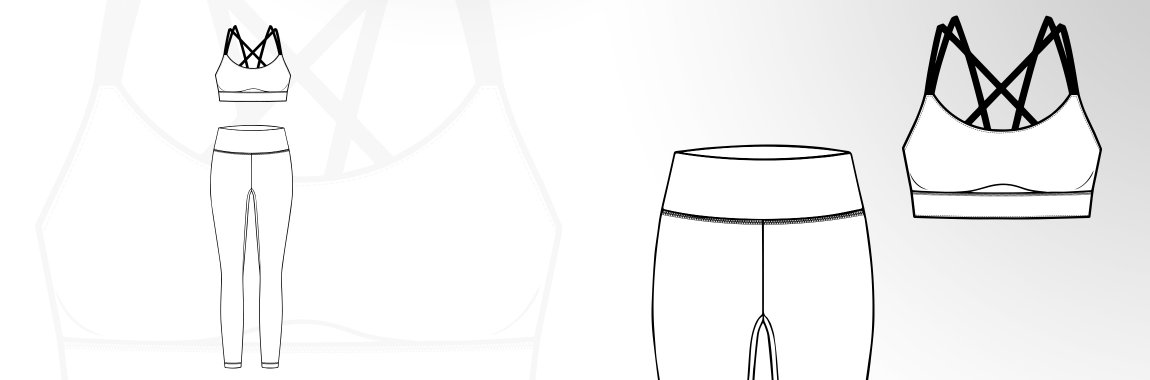
Make leggings
Leggings have been an important part of the fashion industry for many years and are a popular garment for many women. They are available in a variety of colors, fabric textures, and patterns. Most leggings are made from an elastic material blend, such as polyester or nylon with elastane, which fits snugly and is well-suited for sports and leisure activities.
Leggings Production | From fabric to finished leggings
We produce leggings exactly to your specifications! We can customize the cut and style of the leggings, the fabric, the fabric texture (e.g., patterns or logos embedded in the fabric), and your desired color. The material composition can also be tailored to your individual needs. Order your custom leggings today – simply submit an inquiry!
Do you have any questions?
We're happy to help!
Do you have any questions?
We're happy to help!
+49 541 40704311
info_at_rakaille-company.com
The manufacturing process of leggings
The material composition
Leggings are typically made from synthetic materials that are stretchy and durable. Most leggings consist of a blend of polyester and elastane. This material mix is particularly well-suited for creating close-fitting pants because they conform well to the body and offer a high degree of elasticity.
However, a material blend of nylon and elastane, or nylon, polyester, and elastane, is also widely used. The material required for leggings production is knitted specifically according to customer specifications and then dyed in a second step.
The production of the fabric
The first step in making leggings is producing the fabric. In most cases, a blend of different materials is used, such as polyester, nylon, and elastane. These materials offer the good stretch and shape retention that are essential for leggings.
The fabric is knitted on large looms to create a smooth and even surface. However, fabrics with a texture, logo, lettering, or general pattern can also be produced. The fabric is then dyed according to customer specifications.
We exclusively use high-quality yarns from Italy, thus guaranteeing a very high quality so that the leggings will bring joy for a long time.
The next step is dyeing the fabric. The knitted fabric is treated with various dyes to achieve the desired color. This process takes place after the fabric has been manufactured (fabric dyeing). After the fabric has been dyed, it is washed and dried to remove excess dye.
The production of the leggings
Once the fabric is produced, it is used to manufacture the leggings. First, the fabric is cut using specialized machines to create the shape of the leggings. Then, the individual pieces are sewn together to form the leggings. The individual pieces of the leggings are stitched together to achieve the final shape. The seams are carefully inspected and reinforced to ensure they can withstand daily wear.
After the leggings are sewn together, they are washed and dried. Then the label is sewn on and the leggings are ready for sale.
Making leggings | The sewing process
We typically use overlock sewing machines to finish the seams and prevent the fabric from fraying. The leggings are then ironed in special ironing machines to remove wrinkles and shape them.
Finishing of the leggings
Of course, it's possible to print your own logo or brand name on the leggings during production. Using transfer printing, we can print and manufacture the leggings according to your specifications.
For certain quantities, brand logos or lettering can also be woven into the fabric, giving the leggings a very special look. This makes the finished leggings truly unique garments.
Seamless Leggings | Circular Knit
Circular Knit — The versatile knitting process for leggings
Circular knit is a knitting process in which textiles are produced on circular knitting machines. The process is also known as circular knitting and is frequently used for the production of sportswear such as leggings or sports tops.
Circular knitting has gained popularity in recent years as it is an efficient and versatile process that allows for a wide range of designs and materials.
How does Circular Knit work?
Circular knitting (also known as circular knitting) is a knitting technique that uses a multi-needle machine to produce seamless, cylindrical knitwear. The machine has a circular frame, and the needles are arranged in a circular pattern.
The knitting yarn is placed on a spool or cone on the machine, and the machine then begins to move the needles to weave the yarn in a circular motion. The knitted fabric is built up in a spiral around the machine frame until the desired length is reached.
The circular knit process makes it possible to produce a seamless knit fabric for the Seamless Leggings, which means there are no seams that could rub or irritate.
It can also create a wide variety of patterns, textures and colors, as the machine can use different yarns and stitches.
The circular knit process is frequently used for the production of seamless leggings, which require a seamless construction.
Advantages of Circular Knit
Circular knitting offers many advantages over other knitting processes. A major advantage is the ability to produce seamless garments. This means there is no seam at the leg of the leggings, which increases comfort and improves durability.
Another advantage of circular knit is its ability to process a wide range of designs and materials. From cotton to synthetic fibers, most materials can be used in this process. This makes circular knit a versatile process that can be used for a variety of applications.
Circular knit is a versatile knitting process that allows for seamless leggings and a wide range of designs and materials. It is a faster process than traditional knitting and enables larger production of leggings in less time.
The fit is also an important factor in the quality of leggings. A good fit ensures comfort and freedom of movement, while a poor fit can lead to restrictions. The right size and cut are crucial.
The production of leggings is a complex process requiring careful planning and precise handwork. From the design of the pattern to the manufacturing of the leggings, many steps are necessary to produce excellent leggings.
In summary, the production of leggings is a complex process, encompassing everything from material sourcing and pattern making to manufacturing and design. By using high-quality materials and precise craftsmanship, we can produce premium leggings that are comfortable, durable, and fashionable.